



You check the phone again. You already know what you'll find. Nothing, probably. That's not the point.
The point is you can't stop checking, and some part of you hates that you can't stop.
You are not broken. You are not paranoid. Your nervous system did exactly what it was built to do: it noticed danger once, and now it is working to make sure it never misses that danger again. That is not weakness. That is protection.
Building trust after betrayal is the process of restoring a genuine belief in someone's reliability and honesty, rebuilt through consistent behaviour over time rather than through promises alone.
Quick answer:
- Trust after betrayal is rebuilt through consistent action over time, not through apologies or promises.
- Emotional safety comes first and can be established faster than full trust.
- Monitoring a partner's phone or location can create short-term relief but does not build long-term trust.
- Self-trust, your belief in your own judgement, is usually damaged as badly as your trust in the other person.
- The way you interpret what happened determines how fast or slow the repair goes.
Here is what almost nobody tells you: the way you are trying to rebuild trust right now might be the exact thing that is keeping you stuck.
What building trust after betrayal actually means
Most advice on this topic treats trust and safety as the same thing. They are not.
Safety is the absence of active threat. You can create safety fast: full transparency, honest answers, no more hidden information. Trust is different. Trust is the belief, built from repeated evidence, that someone will act in your interest even when you are not watching.
You cannot demand trust. You can only earn it, one small moment at a time, or watch it fail to return no matter how hard someone tries to force it.
Betrayal is not just a broken agreement. It reprogrammes what you believe is possible. Researcher Jennifer Freyd, who developed betrayal trauma theory at the University of Oregon, describes betrayal by someone you depended on as a distinct category of psychological injury, one that affects memory, self-perception, and future relationships differently to ordinary hurt. Read the full definition of betrayal trauma theory.
That single sentence explains why you feel like a different person right now. You are not overreacting. Your brain has filed this event under a different category to normal disappointment.
Betrayal is not a broken promise. It is a broken map, and rebuilding trust means drawing a new one, deliberately, instead of waiting for the old one to fix itself.
Why most people rebuild the wrong way first
You vs most people right now. Most people, the moment betrayal hits, go straight for strategy. New rules. Location sharing. Password access. A list of conditions the other person must meet.
You are probably doing some version of this too. It feels productive. It feels like control returning to your hands.
Tony Robbins teaches a principle that explains why this rarely works on its own: state creates story, and story creates strategy. If you build a strategy for rebuilding trust while you are still in a state of fear and a story of "I will never be safe again," the strategy becomes another form of hypervigilance that looks productive on the surface.
Rules without a changed internal state do not rebuild trust. They rebuild surveillance. And surveillance is exhausting to run forever.
Trust rebuilt through monitoring alone rarely outlasts the monitoring itself. The moment you stop checking, the fear returns, because the fear was never actually resolved. It was managed.
Why don't I trust them even though they've done everything right?
Doing everything right on the outside does not automatically change what is happening on the inside. If your state is still fear and your story is still danger, no amount of correct behaviour from the other person will register as safe. The behaviour and your internal state have to change together, or the evidence in front of you will keep losing to the fear behind you.
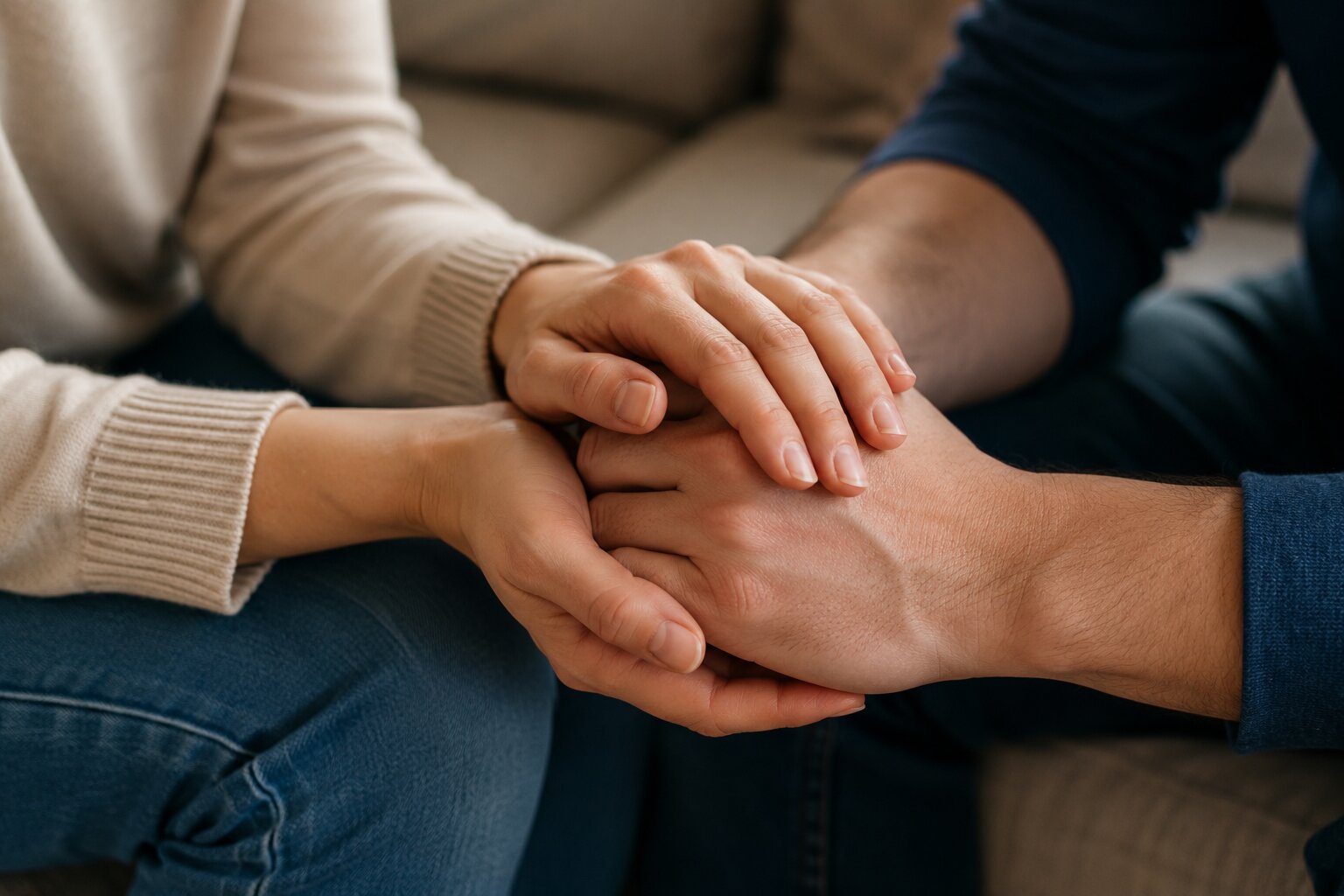
The real starting point: your state, not their behaviour
Here is the shift almost every article on this topic misses entirely.
Before you can accurately judge whether someone else's behaviour deserves your trust, you have to be operating from a state that can actually see clearly. Fear does not see clearly. Fear sees threat everywhere, including in behaviour that is genuinely safe.
Tony Robbins calls this the Triad: your physiology, your focus, and your beliefs control your state, and your state controls how you interpret everything happening around you. A racing heart and three hours of sleep will make an innocent late reply look like evidence. A regulated body and a clear mind will let you actually assess what is in front of you.
How long does it take to trust someone again after betrayal?
There is no fixed timeline, because trust rebuilds at the speed of consistent evidence, not calendar time. What changes the speed is whether both people are doing the internal work alongside the external behaviour. Couples who address the emotional injury directly, rather than only the practical fallout, tend to see faster and more stable repair than those relying on rules alone.
This is where Neuro-Associative Conditioning, one of Tony's core frameworks, becomes relevant. It is not about forcing yourself to feel fine. It is about consciously rewiring what this event means about your future, rather than letting the old story run on autopilot. Betrayal happened to you. It does not have to define what happens next.
Change your story, change your life. Not as decoration. As the literal mechanism by which your nervous system decides what safety looks like now.
The behaviour you are watching for evidence is only half the picture. The other half is the state you are watching it from.
Are you protecting yourself, or just stalling?
There is a specific moment in every trust repair that most people quietly avoid: the decision to actually let someone back in, not just tolerate their presence while staying guarded.
You can spend years in the space between leaving and truly returning. Physically present, emotionally on standby. Staying partly committed while staying fully guarded is its own kind of exhausting, arguably more exhausting than being fully in or fully out, because it costs you energy without ever paying you back in connection.
Tony Robbins has said the quality of your life is the quality of your relationships. Not the quantity of vigilance you maintain inside them.
Staying half in a relationship to avoid being hurt again does not protect you. It just spreads the hurt out over a longer period of time.
You are not most people if you are willing to look directly at this. Most people manage the discomfort of half-trust indefinitely rather than face the bigger question underneath it: am I actually willing to be fully here, or am I protecting myself from ever being surprised like this again?
If you recognise that you have been managing this instead of moving through it, that recognition is not a failure. It is usually the first honest moment in months. Unleash the Power Within is four days built around exactly this kind of shift, the live, physical work of changing your state so decisively that your old story loses its grip. The firewalk on night one is not a metaphor about courage. It is proof, in your own body, that fear and danger are not the same thing. Discover Unleash the Power Within Europe and experience what it feels like to actually decide, rather than just cope.

New agreements, not old promises
Practical repair still matters. Just not the version built entirely on surveillance.
The difference between a rule and an agreement is who it serves. A rule imposed unilaterally to catch someone out serves your fear. An agreement built together, reviewed honestly, and adjusted as safety returns, serves the relationship.
Useful agreements typically include: full transparency about the specific behaviour that caused the injury, a clear and honest way to check in without needing to hide the checking, and a defined point where certain safety measures are revisited rather than kept forever by default.
An agreement reviewed and renewed by both people builds trust. A rule enforced by one person alone only builds compliance.
Can a relationship survive betrayal without professional therapy?
Yes, some relationships repair successfully through their own effort, honest communication, and consistent behaviour change. Professional support significantly increases the odds of lasting repair, particularly when the betrayal involved deception over time, because a trained third party can spot patterns neither partner can see from inside the situation.
Relationship researcher John Gottman describes trust as being built or eroded in what he calls sliding door moments, the small daily instances where one partner either turns toward the other or turns away. Read more on the deeper meaning of trust. Betrayal recovery is not one grand gesture. It is hundreds of small doors, and which way you walk through each one.
Rebuilding trust in yourself
Almost every resource on this topic focuses entirely on trusting the other person again. Almost none of them mention the trust you lost in yourself.
You missed the signs, or you didn't, and either way some part of you is now auditing your own judgement. Can I trust what I see? Can I trust my read on people? Can I trust myself not to walk into this again?
This is often the deeper wound, and the one that quietly outlasts the relationship itself, whether it survives or not.
Research by the Snyder Lab for Genetics at Stanford University, tracking participants of Tony Robbins' live events, found a 300% increase in participants' ability to reprogramme limiting beliefs and a 139% improvement in their cortisol to testosterone ratio, a marker of reduced stress and restored capacity for clear decisions. You can read how Tony Robbins' approach is backed by science. Rebuilding self-trust is not a soft add-on to this process. It is measurable, and it is trainable.
Erin V., who attended UPW, put it this way: "I'd been living with the belief that I needed to stay small and polite to be loved. Sharing my story at UPW helped me break free from those limiting beliefs. I left no longer unseen, I left empowered to live fully." That is what rebuilding self-trust actually produces: not just tolerance of what happened, but a version of you that is no longer negotiating from fear.
Betrayal will test whether you set strong boundaries around what you will and won't accept going forward, and whether you can manage your emotions without letting them run the entire process. Both are learnable. Neither requires you to become a different person, only a clearer one.
If the relationship itself is worth continuing, the work of communicating better with your partner becomes the daily practice that either confirms the new trust or exposes where it still needs work. Understanding the 6 human needs, especially the tension between certainty and connection, explains why you can want closeness and safety at the same time, and why betrayal makes both feel impossible at once. Working through this well, whether the relationship continues or not, is part of overcoming limiting beliefs that started long before this betrayal ever happened, and it is foundational to building meaningful relationships going forward, with this person or the next one.
You arrived here checking a phone you already knew was clean. You now know that certainty was never going to come from the checking. It comes from the state you rebuild in yourself, one honest moment at a time, and the story you choose to carry forward from what happened.
The gap between knowing this and living it is smaller than it feels tonight.
Tonight, do one thing: put the phone down for ten minutes, and instead write one sentence about what you actually need to feel safe, not what you need the other person to prove. That sentence, not the next check, is where the real rebuild starts.