


You already know what needs to change. That is the strange part. You have known for months, maybe years. The relationship, the role, the habit, the conversation you keep avoiding. You can name it. You have named it more than once. And still, nothing moves.
This is the most misunderstood fact about human change. Knowing is not the trigger. If knowing were enough, you would have changed already. Something has to shift before the knowing turns into action, and it is not more information.
Quick answer: The pain of staying the same is the emotional cost of keeping a situation, habit, or pattern that no longer serves you. Change happens when that cost becomes greater than the fear of changing. Tony Robbins calls this "getting leverage on yourself." The human brain moves away from pain faster than it moves toward pleasure, which is why understanding a problem rarely produces change on its own. You do not have to wait for a crisis to create this leverage. You can build it deliberately by making the true cost of staying visible today.
What the pain of staying the same actually means
The pain of staying the same is the accumulating cost of an unchanged life: the relationships that quietly erode, the potential that goes unused, and the version of you that never arrives because you kept waiting for the right moment.
The phrase comes from one of Tony Robbins' most repeated principles: change happens when the pain of staying the same becomes greater than the pain of change. It sounds simple. It is not. Most people hear it as a description of what happens to them, as if the pain is something that will eventually build up on its own and push them into action. That reading is passive. It is also the reason so many people stay stuck for so long.
Here is the more useful reading. The pain of staying the same is not a feeling you wait for. It is a calculation you can run on purpose. You already carry the evidence. You have simply never added it up.
Why your brain keeps you exactly where you are
Your brain is not built to make you happy. It is built to keep you safe. Safety, to the oldest part of your nervous system, means familiarity. A known misery feels safer than an unknown improvement, because the known thing has not killed you yet.
This is why change feels risky even when staying feels bad. The discomfort you have now is predictable. The discomfort of change is not. So the brain, left to its default, chooses the pain it already knows.
There is hard science under this. Research by psychologists Daniel Kahneman and Amos Tversky established that losses affect us far more powerfully than equivalent gains. The pain of losing something is roughly twice as strong as the pleasure of gaining something of the same size. Read that again in the context of your own life. When you consider change, your brain does not weigh the future you could gain. It weighs what you might lose right now, and it doubles the weight. The stability. The identity. The story of who you have always been.
The brain moves away from pain faster than it moves toward pleasure. This is why inspiration alone rarely changes anyone, and why understanding your problem is never the same as solving it.
This is not a character flaw. It is wiring. But wiring can be worked with once you understand it. The same mechanism that keeps you stuck is the mechanism that frees you: if loss drives you harder than gain, then the most powerful thing you can do is make the loss of staying the same impossible to ignore.
How do I know if the pain of staying the same is strong enough to make me change?
You will know the pain is strong enough when staying feels more dangerous than moving. Until then, the pain is still theoretical, and theoretical pain does not move anyone. The test is simple: if you can still comfortably describe your situation as "not ideal but fine," the leverage is not there yet. Real leverage feels like urgency in the body, not agreement in the mind.

The mistake that keeps you waiting
Most people wait. They treat the pain of staying the same like weather, something that will eventually get bad enough to force a decision. They wait for the diagnosis, the breakup, the redundancy, the moment life takes the choice out of their hands. Tony Robbins has a name for this. He says that in life, you need either inspiration or desperation. Most people run on desperation. They change only when the pain finally becomes unbearable, when the cost has already been paid.
You are reading this, which means you are already doing something different. You are looking at the pattern before it forces your hand. That is the whole game. The people who build extraordinary lives are not the ones who feel the most ready or the ones who suffer the most. They are the ones who decided the cost of staying was too high before life made that decision for them.
There is a further trap, and it is subtle. Dissatisfaction on its own does not create change. It creates misery. Research in organisational change captures this precisely. The Formula for Change, developed by David Gleicher and Richard Beckhard, states that dissatisfaction, vision, and first steps must all be present and multiplied together to overcome resistance. If any one of them is zero, the whole thing collapses. Dissatisfaction with a clear vision but no first step produces frustration. Dissatisfaction with first steps but no vision produces anxious, scattered effort. This is why so many people feel the pain of staying the same for years and still do not move. They have the pain. They are missing the other two multipliers.
Dissatisfaction alone does not produce change. It produces suffering. Change requires pain plus a vision worth moving toward plus one concrete first step, all present at the same time.
The pain gets you off the current position. The vision and the first step decide whether you actually go somewhere or simply thrash in place.
How to make the cost of staying visible
If the leverage will not build itself, you build it. This is the part almost no one does, and it is the part that changes everything.
Sit down and answer these questions in specific, felt terms. Not in categories. In detail.
What is this pattern costing you right now, today? Not in theory. Name the exact relationship that is being worn down by your silence. Name the opportunity you talked yourself out of last month. Name the energy you spend every single day managing a situation you have already outgrown.
Then extend the line. Where will you be in five years if nothing changes? Not the worst case. The likely case, the one where you keep doing exactly what you are doing now. Picture it in full detail. The same complaint, five years older. The same distance from the life you actually wanted, except now with five more years of evidence that you are the kind of person who does not change.
That projection is the leverage. It is uncomfortable on purpose. The bill for staying the same is already running, and it has been running longer than you have admitted. Every hour spent managing the consequences of a pattern is an hour not spent building what you actually want. Where focus goes, energy flows. That is not a motivational slogan. It is a description of how your brain allocates its most finite resource, and right now a large part of yours is being spent holding a position that costs you more than change ever would.
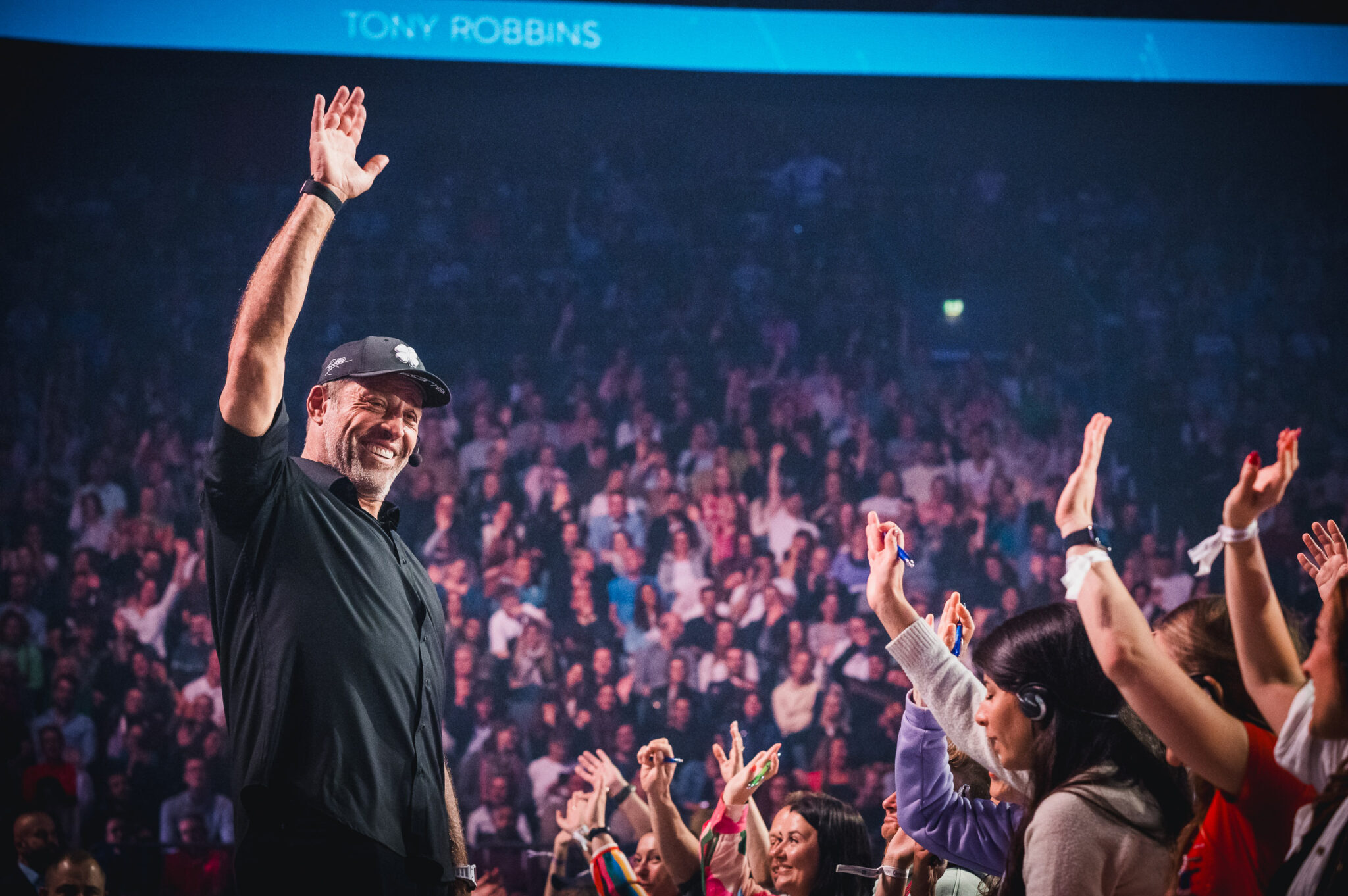
If you have felt this while reading, that discomfort is not a problem to escape. It is the exact leverage you have been missing, and it means you are finally ready to do something with it. This is what Tony Robbins works on live at Unleash the Power Within (UPW): four days of immersive work designed to turn intellectual awareness into a physical, emotional decision your nervous system cannot walk back. The firewalk on the first night is not a metaphor. It is the first proof, in your own body, that the thing you were certain you could not do was never the real barrier. Discover what happens at UPW Europe.
Can I change without hitting rock bottom first?
Yes. Rock bottom is simply the moment the pain finally becomes undeniable, and you can manufacture that clarity deliberately long before life imposes it. By vividly confronting the future cost of an unchanged path, you generate the same emotional leverage that a crisis would, without paying the price of the crisis. This is the entire difference between changing through inspiration and changing through desperation. One you choose. The other chooses you.

What happens when the equation flips
Something specific happens in the nervous system when the pain of staying the same finally outweighs the pain of change. The resistance does not just weaken. It reverses. Inaction becomes the harder option. You no longer need willpower to move, because staying still has become the thing you are moving away from.
This is why willpower fails and leverage works. Willpower fights your wiring. Leverage changes what your wiring is protecting. This is also the foundation of Tony Robbins' method of Neuro-Associative Conditioning, which uses this exact pain-pleasure mechanism to rewire patterns at the neurological level rather than trying to muscle through them.
The change also depends on identity, not just discomfort. As long as the pattern is part of who you believe you are, you will defend it, even when it hurts. Real change asks you to release an old identity, which is often what the fear of change is actually protecting. This is why overcoming limiting beliefs and breaking the cycle of self-sabotage are inseparable from this work. The story you tell yourself about what you deserve is often the heaviest weight on the resistance side of the equation.
When the pain of staying the same finally exceeds the fear of change, willpower becomes unnecessary. You are no longer forcing yourself forward. You are simply refusing to keep paying a cost you can now clearly see.
There is science on what this shift can do. Research by the Snyder Lab for Genetics at Stanford University, tracking participants of Tony Robbins' events, found a 300% increase in participants' ability to reprogram limiting beliefs and a 159% rise in hormones that promote neuroplasticity. You can read more about the science behind Tony Robbins. The point is not the numbers alone. It is that the state you are in when you make a decision changes what your brain believes is possible.
Why do I keep deciding to change and then not follow through?
You keep failing to follow through because you made a preference, not a decision. A real decision closes the exit. Tony Robbins teaches that it is in your moments of decision that your destiny is shaped, and a genuine decision is measured by action taken, not intention declared. If you have decided the same thing many times without moving, the leverage was never strong enough to cut off the retreat. Strengthen the cost of staying until retreat is no longer an option, and the follow-through takes care of itself. This is closely tied to the psychology of decision-making.
The one thing left to decide
You came here already knowing something needed to change. That has not been your problem. Your problem was that the knowing lived in your head, where it was safe and cost you nothing. Now you understand why: the pain of staying the same had never been made real enough to outweigh the comfort of staying still.
That is the only variable that has ever mattered, and it is the one variable you control. You do not have to wait for life to make the cost undeniable. You can make it undeniable yourself, right now, in the next five minutes.
So do this before you close the page. Write down one specific cost of staying exactly as you are. Not a category like "my career" or "my health." Something exact: the raise you never asked for, the call you keep not making, the person you have stopped becoming. Name what it has already taken from you, and what it will take in five more years if nothing moves. That single honest sentence is where every real change has ever started. For more on how Tony frames this shift, see these Tony Robbins quotes on change.