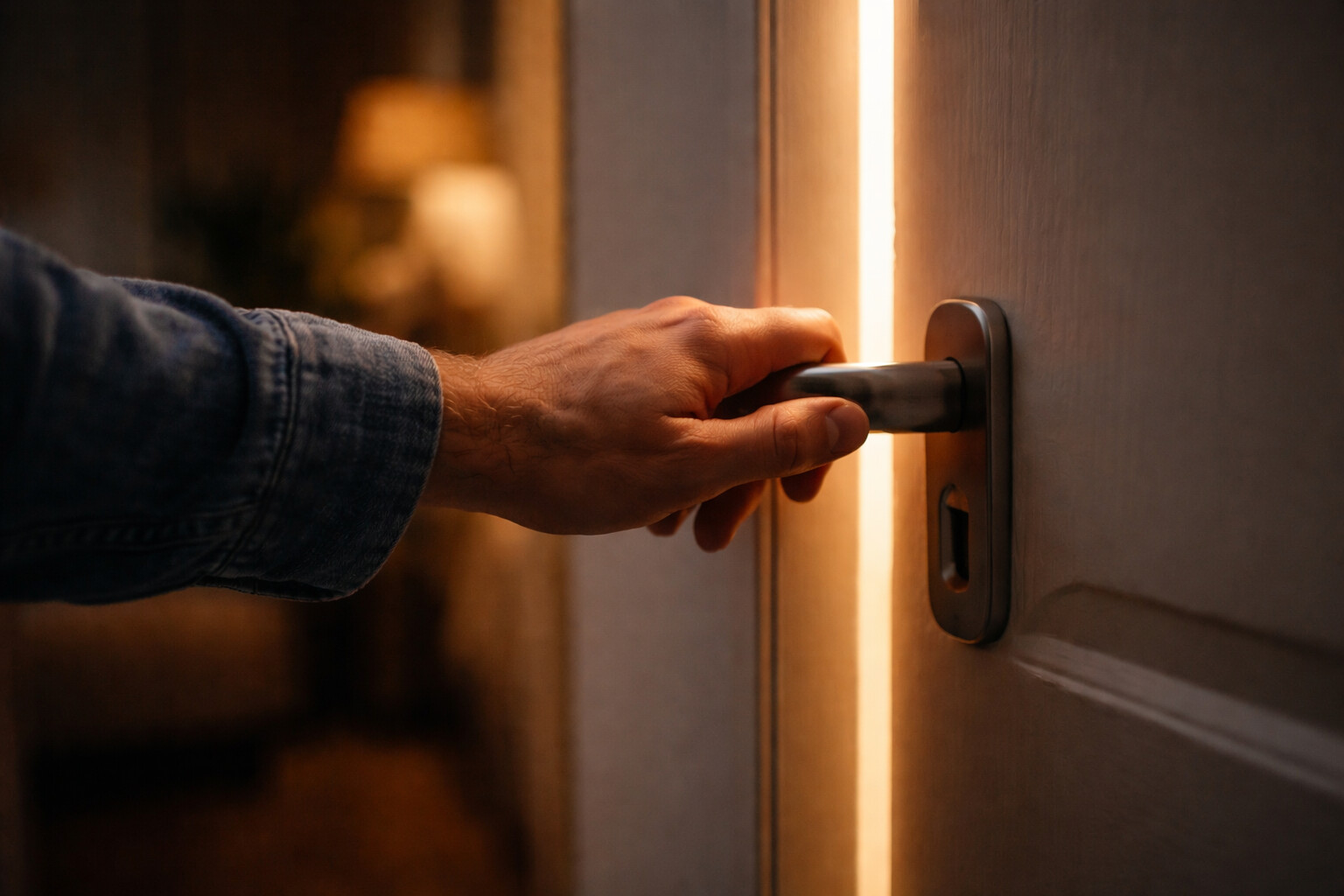



It is late. The house is quiet. And instead of relief, you feel something tighten in your chest.
You reach for your phone. You switch on the television you are not watching. You send a message you do not need to send. Anything to fill the silence.
If that sounds familiar, this article is for you. The fear of being alone rarely looks like panic. It looks like a full calendar, a phone that never leaves your hand, and a mind that never gets a quiet moment.
Key takeaways
- The fear of being alone is anxiety about time on your own. It shapes your schedule, your habits and your relationships, often without you noticing.
- Autophobia and monophobia are the clinical names for an intense fear of being alone. Most people experience a milder, everyday version of the same pattern.
- Being alone and being lonely are different things. Loneliness affects 1 in 6 people worldwide, but solitude itself is neutral.
- In Tony Robbins’ 6 Human Needs framework, the fear of being alone usually means your needs for Connection and Certainty are met only through other people.
- You can reduce the fear of being alone by changing your physiology, rewriting the story you tell yourself, and practising time alone on purpose.
What the fear of being alone really is
The fear of being alone is an anxiety about solitude in which time without other people triggers dread, restlessness or a sense of threat, often strong enough to drive your daily decisions.
It is important to separate two words that are often used as if they meant the same thing. Being alone is a physical fact. Loneliness is a painful feeling of disconnection. The World Health Organization reported in 2025 that loneliness affects 1 in 6 people worldwide and is linked to an estimated 871,000 deaths every year. Loneliness is a serious problem. Solitude is not the same thing.
Here is the uncomfortable truth: you can feel deeply lonely in a full room, and completely at peace in an empty one. The difference is not other people. The difference is you.
Autophobia, monophobia, or everyday fear?
Autophobia (also called monophobia) is the clinical term for an intense, persistent fear of being alone that causes significant anxiety and disrupts daily life. The two words describe the same condition. “Auto” means self and “mono” means alone: the fear of being left with yourself.
The fear sits on a spectrum. At one end is mild unease on a quiet evening. At the other end is real phobia. Typical signs include:
- Anxiety or panic when you know you will be alone at home, especially at night
- Constantly arranging plans so there is never an empty evening
- Needing a screen, a call or background noise whenever you are on your own
- A racing heart, tight chest or shallow breathing when the house goes quiet
- Avoiding travel, hotel stays or time away because you would be by yourself
Most readers will recognise themselves somewhere in the middle. That middle zone is where the fear does the most quiet damage, because it never feels serious enough to address.
Is the fear of being alone a real phobia?
In severe cases, yes. Autophobia is recognised as a specific phobia when the fear of being alone causes intense anxiety and interferes with daily life. For most people, the fear of being alone is a learned emotional pattern rather than a disorder. If your anxiety is severe, constant or comes with panic attacks, speak with a qualified mental health professional.

You are not afraid of silence. You are afraid of what it tells you.
In 2014, psychologist Timothy Wilson and colleagues at the University of Virginia and Harvard ran an experiment that has since become famous. Participants sat alone in a room for 15 minutes with nothing to do but think. They also had access to a button that delivered a mild electric shock.
The result was published in Science. 67% of the men and 25% of the women chose to shock themselves rather than sit quietly with their own thoughts.
Read that again. People chose pain over silence.
Why? Because silence is never really silent. When the noise stops, your inner voice becomes louder. Something is wrong with me. Nobody would choose me. If I stop moving, I will have to face it.
That is the real fear. It is not the empty room. It is the story waiting for you inside it.
Your mind does not go quiet when you are alone. It returns to its oldest story. And whatever you focus on grows. Feed the story of rejection for ten minutes and you will feel rejected, even with no one there to reject you. Where focus goes, energy flows.
The fear of being alone is not a problem with solitude. It is a problem with focus.
Why am I so scared of being alone?
Most people fear being alone because solitude removes the distractions that keep a painful belief out of sight. When there is nothing else to focus on, beliefs like “I am not enough” or “I will be abandoned” take over. Childhood experiences, past rejection and the habit of constant stimulation make this stronger. The fear is learned, which means it can be changed.
The price you pay to never be alone
This is where the fear stops being a private feeling and starts to cost you.
Look honestly at your own life:
- Do you work until you are exhausted because stopping means feeling?
- Do you fill every free hour so that you never have to sit with yourself?
- Do you stay in friendships that drain you because an empty weekend feels worse?
- Do you say yes when you mean no, because no might leave you alone?
The cost also reaches your closest relationships. Research led by Stephanie Spielmann at the University of Toronto, published in the Journal of Personality and Social Psychology in 2013, found that people who strongly fear being single are more likely to settle for less and stay in unsatisfying relationships. When fear chooses your partner, it also shapes how insecure you feel in that relationship.
If you lead a business or a team, the cost is higher still. Leadership is often lonely by design. You make the final call. You carry the weight. And if you never learned to be at peace on your own, you will look for certainty in constant activity, constant approval and constant noise. You will call it drive. Often it is escape.
A fear you never face does not disappear. It makes your decisions for you.
Most people will notice this pattern, feel a moment of discomfort, and go back to scrolling. They will keep paying the price for decades without ever naming it.
You are reading this because some part of you is done paying.
If you can see where this fear has been choosing for you, understanding it is no longer enough. You need to feel, in your body, that you can stand on your own and be completely fine. That is exactly what Unleash the Power Within (UPW) delivers: four days of live, immersive work with Tony Robbins, beginning with a firewalk on the first night that proves your fear is not the final word. Discover Unleash the Power Within Europe
Why Tony Robbins sees this as a needs problem, not a weakness
In more than 45 years of working with over 50 million people in 195 countries, Tony Robbins has returned again and again to one idea: every behaviour is an attempt to meet a need.
His framework of the 6 Human Needs names them: Certainty, Variety, Significance, Connection and Love, Growth, and Contribution. All six are universal. What differs from person to person is how you meet them.
If you fear being alone, two of those needs are usually met through one source only: other people.
- Connection feels available only when someone is with you.
- Certainty feels available only when someone confirms you are okay.
When that one source disappears, even for an evening, both needs drop at the same moment. Your nervous system reads it as danger. That is why an empty room can feel like a threat.
The fear of being alone is not a character weakness. It is a sign that your most important needs depend on one source you cannot control.
Tony teaches that “the quality of your life is the quality of your relationships.” Most people apply that to partners, family and friends. They forget the relationship that is present in every single moment of their life: the one with themselves. If that relationship is built on criticism and fear, no number of people around you will fix it. If it is built on respect, being alone stops being a sentence and becomes a choice.
This is why falling in love with yourself is not self-indulgence. It is how you give yourself a second, reliable source of Connection and Certainty.
Why am I afraid of dying alone?
The fear of dying alone is usually a fear about the future meaning of your life: whether you mattered, and whether anyone will be there at the end. It tends to grow after 40, after a loss, or after the end of a long relationship. In the 6 Human Needs framework, it reflects a need for Certainty and Connection projected decades ahead. The most effective response is not to predict the future but to invest in deep relationships and a strong relationship with yourself today.

How to break the fear of being alone in four moves
Knowing why the fear exists is useful. Changing it requires action. These four moves come from Tony Robbins’ core principles and work best in this order.
1. Catch the story word for word
The next time the fear rises, stop and write down the exact sentence in your head. Not a summary. The actual words. “If I am alone, it means nobody wants me.” “If I stop, everything falls apart.”
A fear you cannot name controls you. A fear written on paper is just a sentence, and sentences can be questioned. Ask: is this true? Where did I learn it? Who would I be without it? Change your story, change your life.
2. Change your physiology before you change your mind
Tony’s peak state triad shows that your state comes from three forces: physiology, focus and language. Fear lives in the body first. Shallow breathing, collapsed posture and a tight chest send your brain a message that you are in danger.
Interrupt it physically. Stand up. Take ten deep breaths, breathing out longer than you breathe in. Move for two minutes. You cannot hold a state of fear in a body that is behaving as if it is safe and strong. State first. Then strategy.
3. Practise being alone on purpose
Avoidance makes fear grow. Planned exposure makes it shrink. Start with ten minutes alone a day with no phone, no music and no screen. Sit, walk or write. Notice what comes up and let it pass.
Increase it step by step: an evening on your own, a meal alone in a restaurant, a half-day walk. Every time you choose solitude and come back unharmed, your nervous system collects new evidence. Repetition is the mother of skill, and being at ease with yourself is a skill.
4. Choose connection from strength, not from fear
The goal is not to need no one. Humans are built for connection, and real connection is one of the strongest forces for health and happiness. The goal is to connect because you want to, not because you are afraid of the alternative.
When you no longer fear being alone, you can build meaningful relationships on purpose. You find it easier to let go of someone who is not right for you. And the people who stay are there by choice, on both sides.
If time alone has already turned into deeper isolation, our guide to overcoming loneliness is a good next step.
Can the fear of being alone ever go away completely?
For most people, the fear of being alone can shrink to the point where it no longer influences their decisions. The feeling may still appear at moments of loss or major change, but it stops being in charge. What changes is not the situation but your relationship to it: solitude becomes something you can handle, and later something you choose. Repeated, deliberate practice is what makes the change last.
The moment the empty room changes
You came here believing you were afraid of being alone. Now you know the fear is really about the story that gets loud in the silence, and about needs that only one source has been allowed to meet. Neither is permanent. Both can be changed, starting in the next room you sit in on your own.
Your past does not equal your future. That includes every evening you spent running from yourself.
Start tonight: put your phone in another room, sit alone for ten minutes, and write down the one sentence your mind repeats when no one else is there. Then write the sentence you would rather live by underneath it.